
Sometimes a show comes around that hits all the right chords. Sometimes two shows come around that hit all the right chords. And sometimes two shows that are about hitting all the right chords come around in the same weekend to hit all the right chords together.
I guess what I’m saying is I want to talk a little bit about Hulu’s High Fidelity and NBC’s Zoey’s Extraordinary Playlist. Because I’m pretty sure they’re secretly the same show.
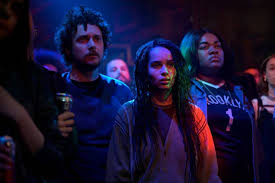
Zoey’s Extraordinary Playlist is a jukebox musical series set in a neon-pink San Francisco starring Jane Levy, formerly of the criminally-forgotten ABC sitcom Suburgatory. High Fidelity is a perpetually night-lit peak TV adaptation of Nick Hornby’s romantic comedy novel of the same name, as well as the 2000 film starring John Cusack. Tonally, it’s hard to find two comedies more different than High Fidelity’s cynical introspection and Zoey’s Extraordinary Playlist’s cheery, worldly optimism.
But seriously. These two shows are the same.
Both shows follow the perspectives of a 20-something female lead living on her own in the city. Both shows force our leads into a love triangle between a soft-spoken, hunky, bearded engaged man and a white-bread, Midwestern-looking nice guy who cares a little too deeply about her. Both leads have a fast-talking, opinionated, plus-sized best friend who exclusively speaks in music references. Both leads have brothers with pregnant wives.
And most importantly, both shows take the stance that music can save lives.
We know High Fidelity believes that because no fewer than three characters say that sentence at some point in the show’s 10-episode first season. Which should be exhausting. But High Fidelity pulls off its portrayal of Brooklyn’s most pedantic and monologue-prone vinyl hunters empathetically enough that it skirts that line.
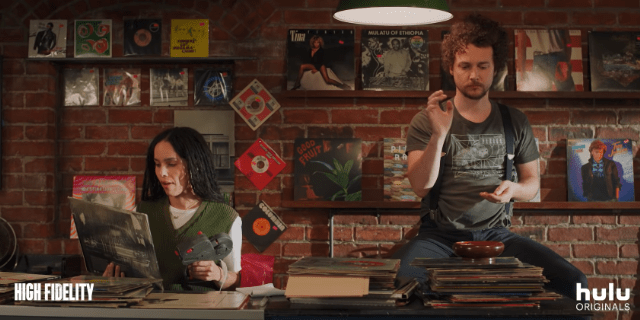
In this adaptation of High Fidelity as in every adaptation of it, music becomes a character. David Bowie gets more face-time in this series than some of the show’s leads. Multiple characters are told to channel their inner Prince. Too-easy potshots at Creed and Phish reveal more about characters than when they stare directly into the camera and tell you how they feel.
One of the running themes in every version of High Fidelity that I’m aware of is that what you like is more important than what you’re like. But this adaptation blurs that distinction by allowing our lovable snobs to expand on their snobbery. There’s a delightful scene in the back half of the season where a character named Simon launches into a passionate defense of Disco that encapsulates why he likes something by explaining who he is. Scenes like this are the strength of High Fidelity, using music as metaphor to speak to a closed-off character’s inner thoughts.
Of course, that last sentence is actually the premise of Zoey’s Extraordinary Playlist. Log line: One day Zoey wakes up and learns that she can hear other people’s inner thoughts in the form of popular songs. It’s pretty much Eli Stone without the weird hangup on George Michael.
Zoey’s has only aired two episodes so far. But they’ve both landed for me. Because whereas a show like High Fidelity likes to bury its music references in layers upon layers of subtext and rock criticism, Zoey’s references music with all the earnestness of a classic Broadway production.
When a character is cocky, he sings “All I Do Is Win.” When a character is sad, he sings “Mad World.” When characters need help, they sing “Help!” When a character thinks he’s in love, he sings “I Think I Love You.” When a character wants to tell someone that he can see their true colors, he sings “True Colors.” You get the point.
Just like High Fidelity’s unceasing proclamations about the power of music, Zoey’s on-the-nosedness should be exhausting. An interpretative ballet about lonely people who want to fall in love set to Whitney Houston’s “I Wanna Dance With Somebody” is about as on-the-nose as a scene can get. But it also just kind of works.
The strength of Zoey’s Extraordinary Playlist is its perspective. Songs become the clues in its procedural mystery-of-the-week style, with plots A, B and C all being solved by different musical cues. Take the second episode of the show which aired Sunday night. In the A plot, Zoey has to learn to deal with the revelation that her best friend has feelings for her. She knows this because he sings Sucker by Jonas Brothers at her. In the B plot, she has to figure out why her palsy-stricken dad is trying to sing Van Morrison’s Moondance at her mother.
In the pilot episode, I felt myself drawn mostly to the musical numbers. The other scenes were interstitial connective tissue that got me from Tears for Fears to The Partridge Family. By episode two, though, I felt as if the musical numbers were less spectacle and more significant. They weren’t forced or out-of-place. They wove into the narrative of stories the way musical numbers did in two of my favorite shows ever, Flight of the Conchords and Crazy Ex-Girlfriend.
If I haven’t made this clear after about 15 paragraphs, I really like both of these shows. It’s hard for any show to be more up my alley than High Fidelity. Any show that directly calls out my Weezer fandom in the pilot, discusses how Blackstar compares against Bowie’s golden years (pun intended) and has an episode that feature two different songs by The Replacements gets my seal of approval. And Zoey’s is the type of event viewing I haven’t gotten from TV much in the streaming era. It’s a show with a formula built to last but conflict that doesn’t necessarily rely on the formula.
Naturally, High Fidelity is the show that’s probably built to last. Which is a good thing. I think of High Fidelity in the same way I think of timeless stories like King Arthur, Robin Hood, The Hunchback of Notre Dame and La Boheme. High Fidelity is less a singular work and more a standard storytelling template that every generation can and should adapt in different forms. It’s been a book, a movie, a Broadway musical and now it’s a TV show. And it’s a damn good TV show with convincing performances, tight writing and risk-taking plot choices all led by a powerhouse clinic in apathy put on by Zoe Kravitz.
(Side note: It took me three or four episodes to come to terms with Kravitz’s portrayal of Rob. She doesn’t lean into John Cusack’s lethargic and sadsack-y portrayal from the film. She trades that by leaning into how much of an inattentive ass Rob is. At first that was jarring to me. But I came to like it. A lot. It just shows how versatile this story can be. It doesn’t matter what kind of jerk your lead is! He or she can be any type of jerk you want!)
But I hope Zoey’s can survive too. Because now it’s time for me to get exhausting: I genuinely do believe that music is a great healer. And while High Fidelity makes a great argument about how an over-consumption of music can alienate and isolate you from the tasteless hordes, Zoey’s Extraordinary Playlist makes a pretty solid argument about the regenerative qualities of a good bop.
These two shows are endlessly interesting to me. Circumstantially, they’re almost identical. Music-rich explorations into the difficult work-life balances of millennials in the big city don’t come around too often, let alone twice in the same weekend.
But I think it’s best to consider High Fidelity as a yin and Zoey’s Extraordinary Playlist as a yang. For every shoegazing Brookylnite who wants to tell you about how Cyndi Lauper’s Memphis Blues doesn’t suck, there’s a smiling San Franciscan singing Kiki Dee.
So yeah. Maybe music can save lives. Maybe it can’t. But it does make for some compelling television, at least in my book.
 The Sitcomologist